"This course was a life saver, helped me understand my triggers and finally stay calm. I think it saved my relationship and I have self-respect again"
Online Anger Management Course
Learn practical CBT and DBT skills to understand and manage anger
How the course works
My Anger Management course gives you a structured way to learn and practise skills in your own time. It is self-paced psychological education for adults aged 18+ who want to work on their own anger.
The course includes CBT, DBT and mindfulness skills, with video lessons and worksheets.
Watch a free lesson: What is anger? (4:46)
I want you to be happy and find my course useful, if you do not find it useful, I shall issue a full, no-questions-asked refund within the first 10 days.
Look inside the course
In the video below I take you through the course, letting you see how it works.
It's important to watch this video as it can help you decide if this is going to help or not. There are reviews for this course that you can look at, but seeing the inside of the course helps you see how it works as I talk you through it.
Anger Management Curriculum
Introduction and Overview
Available in
days
days
after you enroll
DBT
Available in
days
days
after you enroll
DBT Mindfulness Skills
Available in
days
days
after you enroll
Distress Tolerance Skills
Available in
days
days
after you enroll
Emotion Regulation
Available in
days
days
after you enroll
- Primary and Secondary Emotions (4:00)
- Worksheets
- Calming physical sensations of anger (3:09)
- DBT and your angry thoughts (3:29)
- Judgmental Thoughts (1:41)
- Assumptions (1:28)
- Blame (1:20)
- Letting go of judgments and assumptions (4:52)
- Worksheet: Letting go
- Letting go of angry thoughts (5:25)
- Opposite to emotion (6:55)
Interpersonal Effectiveness Skills
Available in
days
days
after you enroll
CBT
Available in
days
days
after you enroll
Pulling it all together
Available in
days
days
after you enroll
Feedback
Available in
days
days
after you enroll
Dr Elaine Ryan
Why I created this programme
I am Dr Elaine Ryan, a Doctor of Psychology with over 20 years’ clinical experience, including working in the UK NHS as a Highly Specialist Psychologist.
I created this anger management programme to give you access to the same kind of structured psychological tools I use when helping people understand and change difficult emotional and behavioural patterns.
This is not a collection of vague anger tips.
It is not motivational advice.
It is not simply “take a deep breath” and hope for the best.
It is a clear, practical, skills-based programme that teaches you how to understand your anger, spot the warning signs earlier, calm the physical surge, work with angry thoughts, and respond in a way that protects your relationships, your work, your health, and your self-respect.
I want the course to be genuinely useful. If it is not the right fit for you, you are covered by a 10-day no-questions-asked refund.

Understanding Anger
The following video is how I explain anger to clients
Who this course is for
This course may be helpful if:
- you become angry more quickly than you want to
- you go from calm to furious and only understand it afterwards
- you regret what you say or do when angry
- you struggle to calm down once you have been triggered
- you keep getting stuck in the same arguments
- your anger is affecting your relationship, family life, parenting, work, or self-respect
- people close to you have become wary of your temper
- you feel irritable, resentful, wound up, or constantly on edge
- you want a private, structured way to work on anger in your own time
- you have tried general advice before but need something more practical and psychologically grounded
This course is for adults aged 18+ who are willing to work on their own anger.
It is not designed to make you a different person. It is designed to help you have more choice over what you do when anger shows up.
How this programme helps you understand and change anger
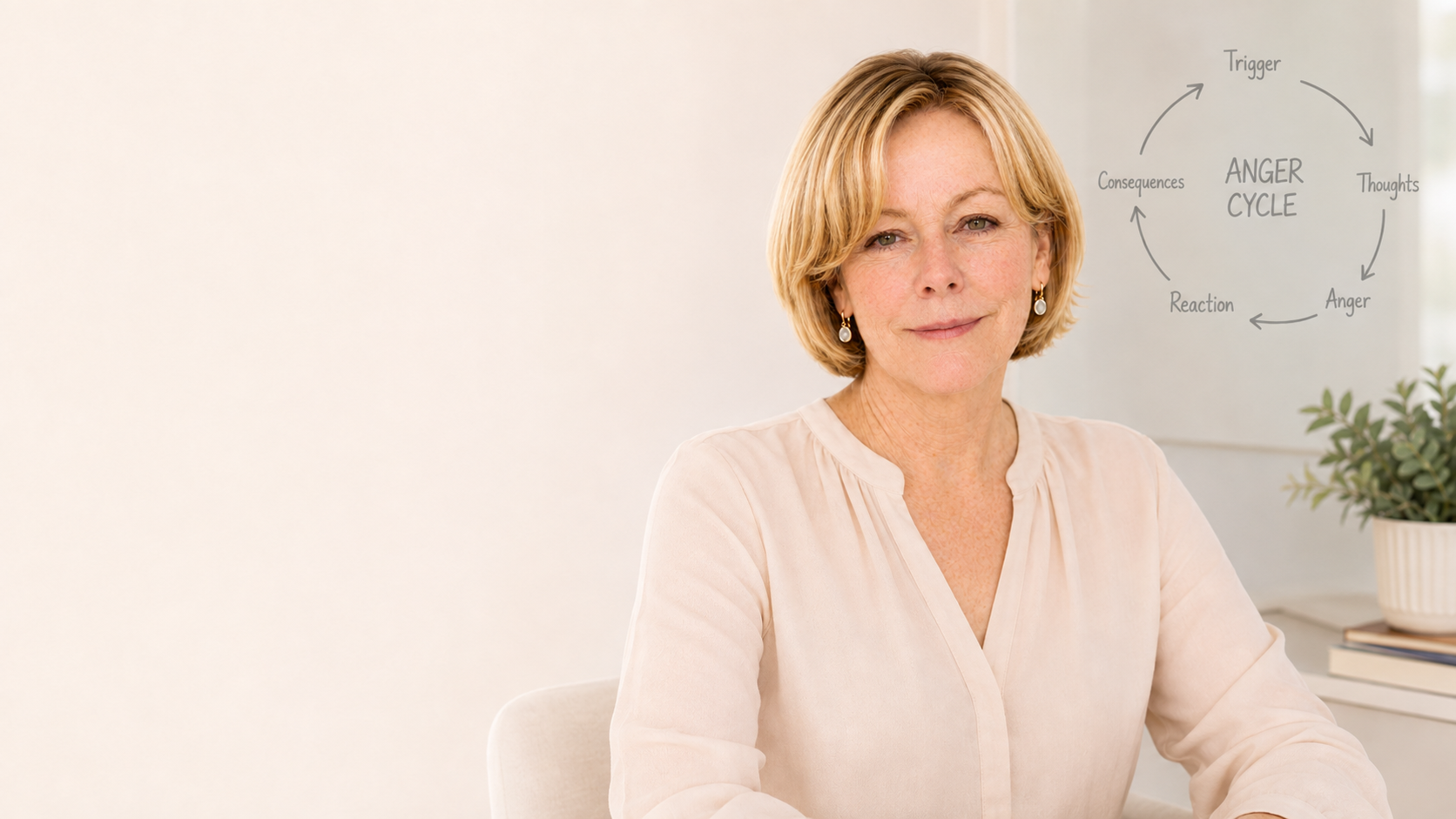
Anger does not come out of nowhere. It follows a pattern.
For some people, it builds gradually on top of stress, frustration, resentment, or feeling overwhelmed. For others, it is rapid and reactive, triggered by perceived threat, criticism, disrespect, or loss of control. For many, it has become an automatic learned response.
Once anger becomes patterned, it can start to feel as though it “just happens.” But that is not the same as it being unchangeable.
This programme helps you identify:
- what triggers your anger
- what happens in your body as it escalates
- the thoughts that intensify it
- the behaviours that keep the cycle going
- what to do differently at each stage
Once you understand your pattern, the work becomes much clearer.
You learn practical, evidence-based tools to reduce escalation, increase self-control, and respond more effectively in the moments that matter most.
These are not abstract ideas. They are concrete psychological strategies you can begin using immediately.
What you will learn
By working through the programme, you will learn how to:
- identify your personal anger triggers
- recognise early warning signs in your body
- understand the thoughts that intensify anger
- use DBT-informed skills to tolerate the heat of the moment
- use mindfulness to pause before reacting
- calm the physical sensations of anger
- notice judgement, assumptions, blame, and “they did it on purpose” thinking
- use CBT tools to challenge angry interpretations and core beliefs
- communicate more assertively without attacking or withdrawing
- use practical repair after an outburst
- build a repeatable anger plan you can use in real life
The aim is not to remove every trigger. That is impossible.
The aim is to help you stop handing control to anger.
What is inside the programme?
You get immediate access to a structured online course that you can work through in your own time.
The lessons are practical and easy to follow. You do not need to rush. You have 12 months of access, so you can watch, practise, return to lessons, and build the skills gradually.
The most important part is not how quickly you finish.
The most important part is repetition.
Anger becomes automatic through repeated patterns. New responses also need repetition. This course is designed to help you learn, practise, review, and use the skills when you need them.
Start here: understanding anger
You begin by learning what anger is and how the course is structured.
This gives you a clear starting point rather than dipping in and out randomly.
You will begin to understand anger as a process involving your body, thoughts, emotions, urges, and behaviour.
That matters because once you can see the process, you can start to interrupt it.
DBT: skills for intense emotion
You are introduced to DBT and how DBT-informed skills can help with anger.
DBT is useful because it focuses on practical skills: what to do when emotion is strong, when the urge to react is high, and when you need to stay steady enough to make a better choice.
This part of the programme helps you begin developing the ability to pause, observe, and respond more deliberately.
Mindfulness skills for anger
Mindfulness is not included as a vague relaxation exercise.
It is used as a practical anger management skill.
You learn how to observe what is happening inside you, describe your experience more accurately, and notice thoughts without immediately acting on them.
This is important because anger often narrows your attention. You may only see the insult, the unfairness, the mistake, or the threat.
Mindfulness helps you create enough space to see more clearly.
Distress tolerance: what to do in the heat of the moment
When anger is intense, insight alone is not enough.
You need skills that help you get through the surge without making things worse.
This section teaches practical distress-tolerance tools, including coping strategies and the R.E.S.T. skill.
The focus is on getting through the high-intensity moment safely and effectively, so you can return to the situation with more control.
Emotion regulation: reducing escalation
This section helps you understand the difference between primary and secondary emotions.
For many people, anger is not the only emotion present. There may also be hurt, fear, shame, exhaustion, anxiety, grief, or feeling rejected.
You will learn how to calm the physical sensations of anger and work with the thoughts that keep it going.
This includes looking at:
- judgemental thoughts
- assumptions
- blame
- angry interpretations
- letting go of thoughts that keep the fire burning
- using opposite action when anger is pulling you towards behaviour you will later regret
This section is especially important if you find yourself replaying events, building a case in your mind, or becoming more angry the more you think about what happened.
Interpersonal effectiveness: handling conflict differently
Anger often causes problems in relationships because it affects communication.
You may attack, defend, withdraw, become sarcastic, shut down, or push harder to be heard.
This section introduces interpersonal effectiveness skills, including DEAR MAN, to help you ask for what you need, set boundaries, and communicate more clearly.
The goal is not to become passive.
The goal is to express yourself without escalating the conflict.
CBT for anger
CBT helps you understand the link between what you think, how you feel, and what you do next.
In this section, you learn how angry thoughts can intensify the emotion and how to begin questioning them.
You will look at mistakes in thinking, beliefs, and core beliefs that may be feeding your anger pattern.
This is not about forcing yourself to “think positive.”
It is about learning to think more accurately when anger is trying to convince you that there is only one way to see the situation.
Pulling it all together
Finally, you bring the work together into a practical plan.
This is where you begin to see your own anger pattern more clearly:
- your triggers
- your warning signs
- your thoughts
- your urges
- your best exit routes
- your repair steps
- the skills you need to practise most
The aim is to leave you with a repeatable framework, not just information.
How this programme helps you change your anger response
Anger is not the problem. The problem is what happens as anger builds: body tension, impulsive urges, judgmental thoughts, blame, assumptions, and reactions that come too quickly.
This programme teaches you how to recognise the build-up earlier, slow the reaction, regulate the emotion, and respond differently. You will learn distress-tolerance skills for the heat of the moment, emotion-regulation tools to reduce escalation, cognitive tools to challenge angry thinking, and communication skills to handle conflict more effectively.
The goal is not to remove every trigger. The goal is to help you stop handing control to anger.
What's inside the programme?
You will get immediate access to a practical, structured programme that helps you understand how anger works and what to do differently.
- understand the build-up of anger in body, thoughts and behaviour
- spot your triggers, judgments, assumptions and blame patterns
- use DBT-informed skills to regulate intense emotion
- learn mindfulness tools that help you pause instead of react
- calm the physical sensations of anger before they tip into action
- use CBT to challenge angry interpretations and core beliefs
- improve communication and boundaries using assertive skills
- build a repeatable plan you can use in real life
“From the first lesson, I had strategies I could use straight away. No fluff—just real tools that work. I’m more confident and in control than I’ve ever been”
“I noticed a change within the first week. I wasn’t exploding over small things anymore.”
"Ive read other advice before, but it always felt like it was written by someone who didn’t get it. I think Elaine knows what its like to lose your temper and regret it. The examples were real, not textbook, and that made me feel less judged. It felt like I had someone on my side instead of someone lecturing me"
“I’ve spent more on therapy sessions than I did on this whole course, and to be honest, I was skeptical at first, but it's the first thing that made sense and helped me get a handle on my temper. It’s not just money saved—it’s years of stress I won’t be wasting anymore”
“I thought stress just came with the job, but my outbursts were hurting my job. These tools helped me manage conflict and stay calm under pressure. People in work have noticed the change”
FAQ
Is this for adults only?
Yes. This programme is designed for adults 18+.
Does this replace therapy?
No. This is a structured self-help educational programme. It can be very useful on its own or alongside therapy, but it is not a substitute for assessment, psychotherapy or urgent support.
What if my anger is explosive?
The programme is designed to help you notice escalation earlier and learn what to do differently. If there is current violence, coercion, serious risk, or fear for safety, self-help alone is not enough and specialist support is the safer option.
Do I need to be calm to start?
No. Most people begin because anger is already affecting life. The programme is designed to give you practical steps you can start using quickly.
How much time do I need each week?
Most people do best with short, consistent practice several times a week rather than one long session.
Can I use this while in therapy or taking medication?
Yes. Many people use skills-based programmes alongside therapy. Medication questions should always be discussed with your GP or prescriber.
Practical Steps
It's very easy to start