PSYCHOLOGIST-DESIGNED SELF-HELP COURSE
Overcoming Social Anxiety
Understand the cycle that keeps social anxiety going—and learn how to change it through clear teaching, manageable behavioural experiments and evidence from your own life.
For adults who feel watched, judged or exposed in conversations, work situations, public speaking, dating, eating, writing—or simply being seen.

16 captioned video lessons • 133-page fillable and printable workbook • practical exercise and knowledge check in every lesson
Immediate access to the complete course for 12 months • One-time payment • 10-day refund policy
Course overview
Watch this short introduction to see what the course covers, how the method works and whether it is a sensible fit for you.
Does this sound familiar?
Social anxiety rarely begins when the conversation starts. It may begin hours or days beforehand, while you rehearse what to say, imagine how you will look or consider cancelling. During the situation, your attention can turn inwards as you monitor your face, voice, hands, body or words. Afterwards, you may replay everything and judge yourself far more harshly than anyone else did.
You may recognise some of these patterns:
- avoiding situations you would otherwise like to take part in
- keeping answers short or staying quiet so that you cannot say the wrong thing
- rehearsing sentences instead of listening naturally
- hiding blushing, shaking, sweating or changes in your voice
- checking other people’s faces for signs of judgement
- over-preparing for meetings or public speaking
- feeling watched while eating, writing or completing ordinary tasks
- going blank and believing you have nothing interesting to say
- replaying conversations for hours afterwards
- wanting connection or dating, but feeling unable to let yourself be known
If this is familiar, the problem is not that you have failed to “be confident”. Social anxiety is a cycle involving prediction, attention, protection, avoidance and learning. This course helps you see that cycle clearly and begin changing it.
Curriculum
- When Blushing Feels Like the Main Problem: Visible Anxiety, Monitoring and the Fear of Being Found Out (5:13)
- Shaking, Sweating and Voice Changes: Working With Bodily Signs Without Making Them the Test (5:00)
- Going Blank and Running Out of Things to Say: Attention, Working Memory and Shared Conversation (5:00)
- When You Feel Watched: Eating, Writing and Doing Ordinary Tasks in Front of Others (5:04)
- Meetings and Public Speaking: Preparation, Attention and Recovering in Performance Situations (4:50)
- Dating and Social Connection: Reciprocity, Uncertainty and Letting Yourself Be Known (5:12)
Trying to look calm, say the perfect thing or make a good impression can become part of the problem. The harder you work to prevent embarrassment, the less opportunity your brain has to discover what would actually happen without all that protection.
The course is built around one important idea:
Change comes from new evidence—not from forcing yourself to feel calm.
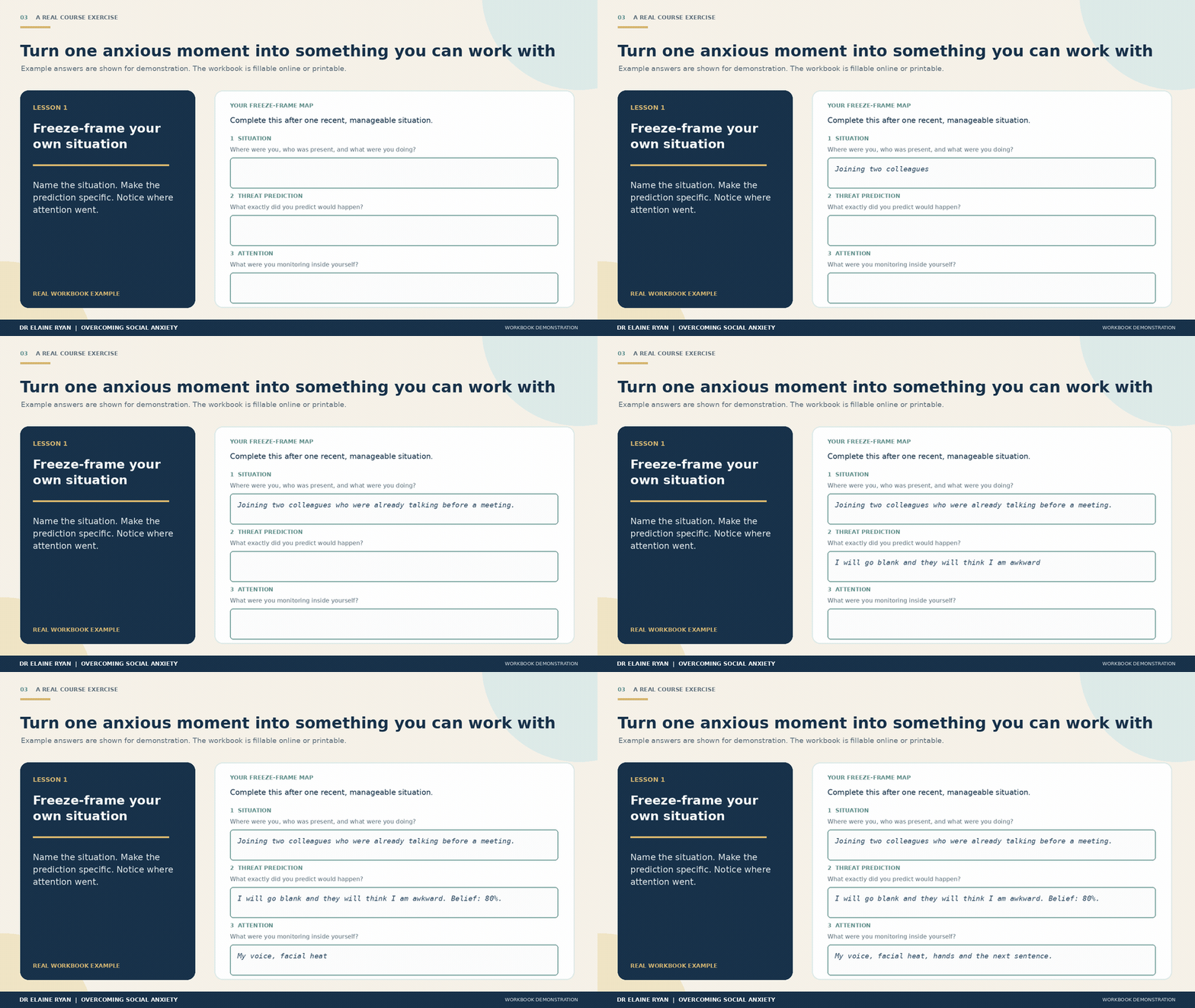
You will learn how to make a feared prediction specific, enter an ordinary and repeatable situation, reduce one unnecessary safety behaviour, notice what actually happens and carry that learning into the next situation.
The aim is not to guarantee that nobody will ever judge you. It is to help you discover what is more likely, what you can handle and what changes when anxiety is no longer directing the whole interaction.
What you will learn to do
By working through the course, you will learn how to:
- map what happens before, during and after a real social situation
- recognise when your attention has turned inwards and bring it back to the person or task
- identify safety behaviours that give short-term relief but prevent new learning
- understand anticipatory worry and the predictions it creates
- respond differently to critical replay after an event
- plan manageable exposure and behavioural experiments
- use observable evidence rather than anxiety’s verdict
- cope more flexibly when an awkward moment, mistake or sign of anxiety really does occur
- examine the rigid rules and self-criticism beneath the anxiety
- build a realistic plan for setbacks, repetition and continued practice
You are not being asked to become a different personality. You are learning a different way to respond to uncertainty, attention and fear.
What you receive
This is a complete, self-paced learning programme—not a short collection of videos.
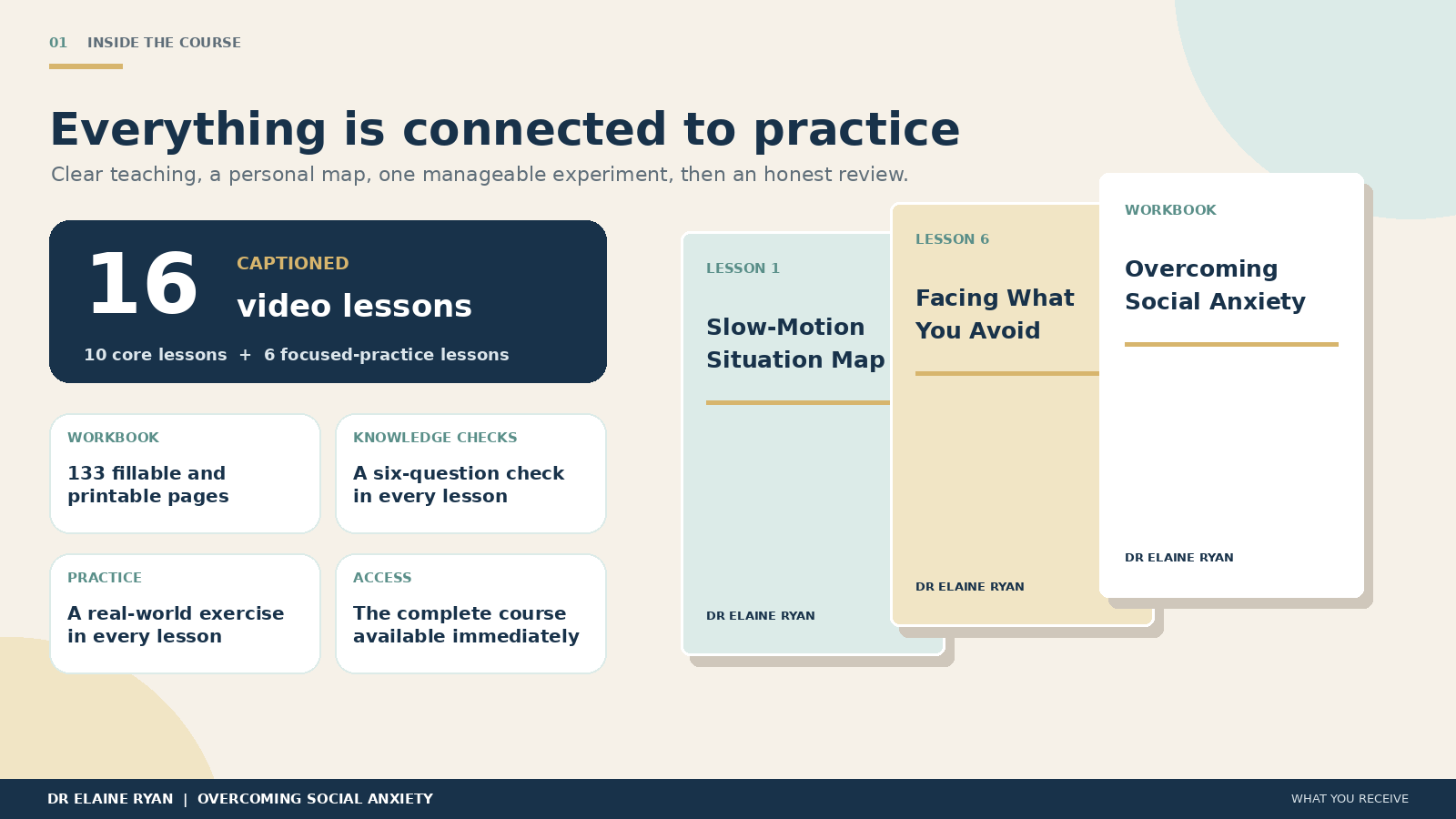
16 captioned video lessons
Ten lessons teach the core method. Six focused-practice lessons apply it to problems that often need more specific attention.
A 133-page learner workbook
The workbook is fillable on screen and printable. It includes clear explanations, worked hypothetical examples, personal mapping exercises, experiment planners and review records.
A practical exercise in every lesson
Each lesson takes the teaching into daily life through one specific, manageable task. The purpose is to gather useful evidence—not to perform perfectly.
A six-question knowledge check in every lesson
Short checks with explanations help you confirm that you have understood the important idea before moving on.
Immediate access to the complete course
Begin as soon as you enrol and work at a pace that allows you to practise and repeat what you are learning.
How the course works
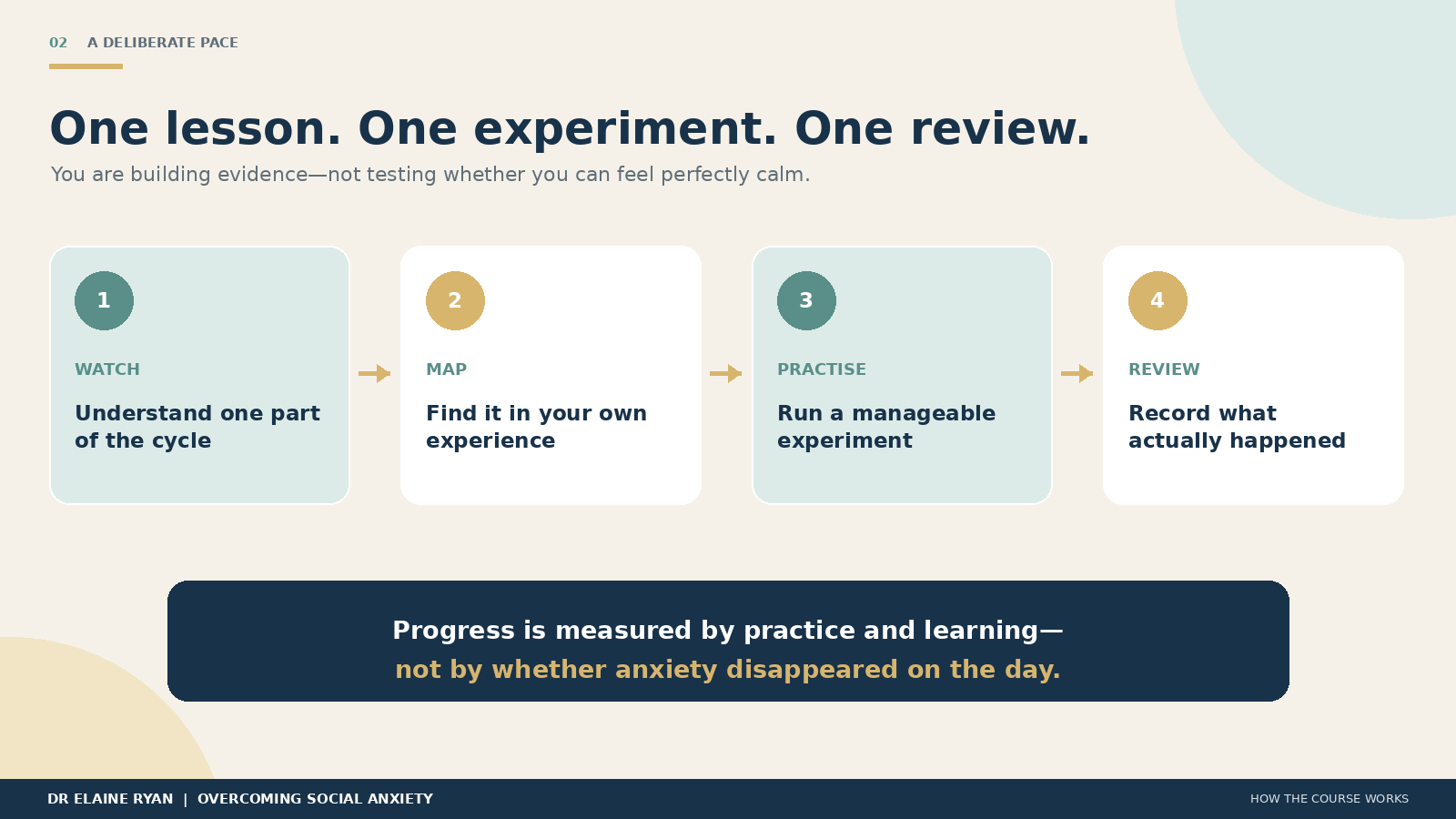
This course is not designed to be binged. Understanding matters, but change depends on what your brain learns from experience.
Watch
Each video explains one part of the social-anxiety cycle in clear, practical language.
Map
Use the companion workbook to find that mechanism in one of your own recent situations.
Practise
Choose an ordinary, manageable experiment. You will not be told to begin with the most frightening thing you can imagine.
Review
Record what a camera or microphone could have observed. Separate what happened from what anxiety concluded it meant.
Progress is measured by practice and learning—not by whether you felt perfectly calm on the day.
The complete course
Part One: The core method
Work through these ten lessons in order. Together, they show how social anxiety is maintained and where change can occur.
Lesson 1 — One Social Situation in Slow Motion
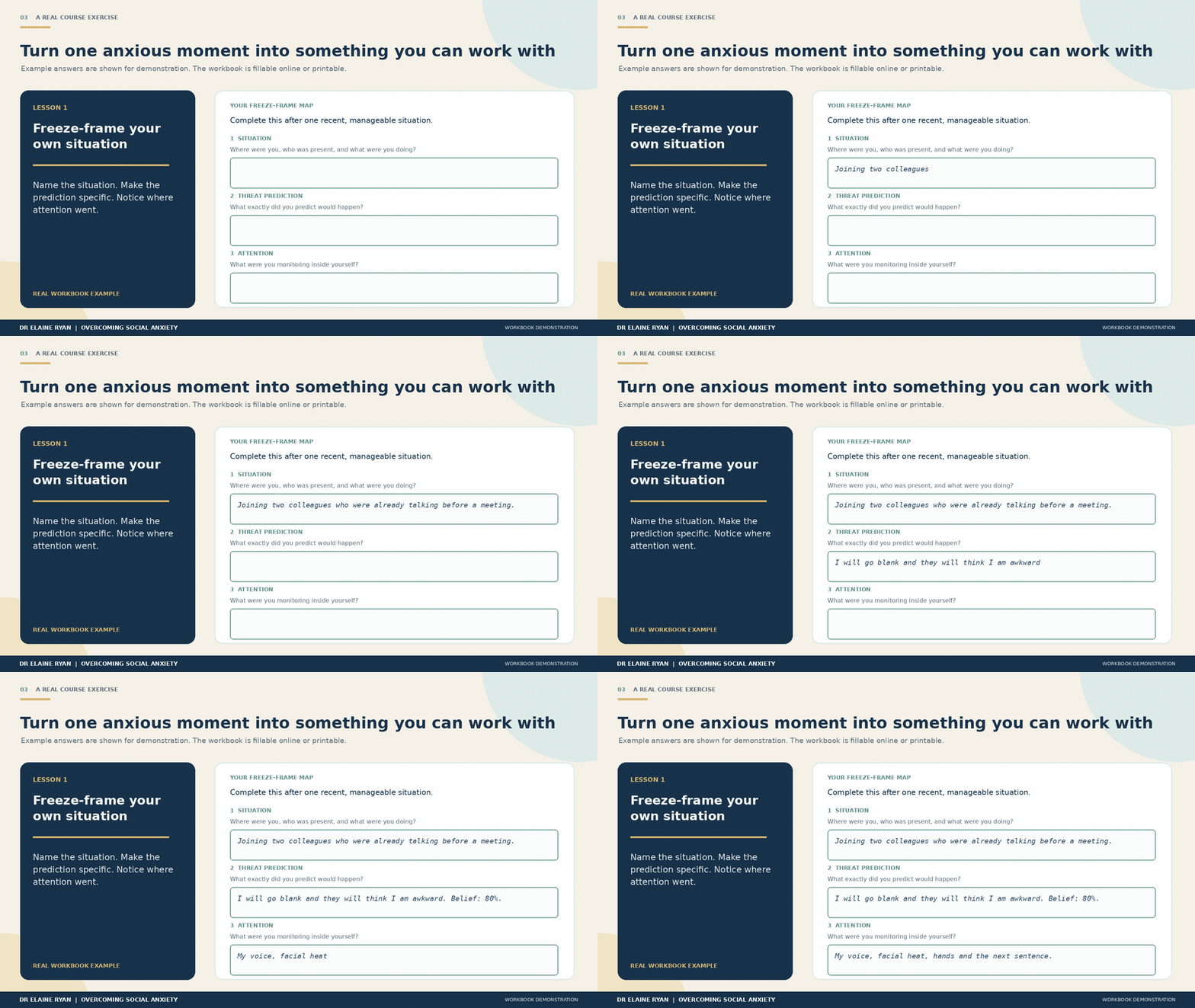
Slow down one real situation and map the prediction, body response, inward attention, self-image, safety behaviours and review afterwards.
Lesson 2 — Where Your Attention Goes
Understand the self-focus trap and practise bringing attention back to the person, task and environment around you.
Lesson 3 — Safety Behaviours
Identify the things you do to prevent, conceal or control a feared outcome—and understand how they can stop your prediction being properly tested.
Lesson 4 — Before It Even Happens
Examine anticipatory worry, mental rehearsal and the predictions that can make a situation feel dangerous before it has begun.
Lesson 5 — After It Is Over
Learn how critical replay and threat-biased memory can strengthen the next anxious prediction, and practise a more evidence-based review.
Lesson 6 — Facing What You Avoid
Plan exposure as new learning: specific, manageable and repeatable, with a clear prediction to test.
Lesson 7 — Seeing Yourself More Accurately
Use external information and video feedback carefully to compare the image in your mind with what can actually be observed.
Lesson 8 — When the Feared Thing Happens
Prepare for mistakes, awkward moments and signs of judgement without treating them as proof that you cannot cope.
Lesson 9 — The Rules Beneath the Anxiety
Explore perfectionistic standards, self-criticism and the feared version of yourself that anxiety is trying to prevent other people from seeing.
Lesson 10 — Keeping Change Going
Consolidate what you have learned, plan future experiments and respond to setbacks without turning them into a verdict on your progress.
Part Two: Focused practice
Complete the core method first. Then use the focused lesson or lessons that match the situations in which the cycle is still strongest.
Lesson 11 — When Blushing Feels Like the Main Problem
Work with visible anxiety, monitoring and the feared meaning of being seen to blush.
Lesson 12 — Shaking, Sweating and Voice Changes
Practise responding to bodily signs without making their disappearance the test of whether a situation went well.
Lesson 13 — Going Blank and Running Out of Things to Say
Understand how inward attention affects working memory and learn to return to a shared conversation rather than performing it alone.
Lesson 14 — When You Feel Watched
Apply the method to eating, writing and completing ordinary tasks in front of other people.
Lesson 15 — Meetings and Public Speaking
Work with preparation, audience attention, safety behaviours and the review that follows speaking in front of others.
Lesson 16 — Dating and Social Connection
Practise reciprocity, uncertainty and allowing yourself to be known without trying to control the entire impression you make.
---
A workbook you will actually use
The workbook is the bridge between understanding the method and applying it to your own life.
Each companion helps you:
- choose one recent and manageable example
- make the feared outcome specific
- notice where your attention went
- identify what you did to protect yourself
- plan one useful experiment
- record what actually happened
- decide what your brain needs to test next
You can type directly into the workbook or print the pages and write by hand. Worked examples show you the level of detail required without using patient stories.

About your instructor
Dr Elaine Ryan, PsychD
Chartered Psychologist • More than 20 years’ experience • Former NHS Highly Specialist Psychologist
I created this course because social anxiety is too often reduced to a lack of confidence or a list of positive-thinking tips. In practice, the difficulty is usually maintained by a connected set of processes: what you predict, where your attention goes, how you try to protect yourself and what you conclude afterwards.
My role in the course is to help you make those processes visible and workable. I explain the psychology in plain language, show you how the pieces connect and guide you towards manageable experiments that produce information you can use.
I have worked with anxiety-related difficulties for more than 20 years, including within the NHS and private practice. I also understand anxiety personally. That combination has shaped the way I teach: clinically responsible, practical and without judgement.
## 10. Is this course right for you?
### This course may suit you if:
- social anxiety is limiting your work, relationships or ordinary daily activities
- you avoid situations or endure them while monitoring and judging yourself
- you want more than general advice about confidence
- you are willing to practise in manageable real-life situations
- you prefer a structured, psychologist-designed programme that you can use privately and at your own pace
### This course is not the right form of support if:
- you need a diagnosis or an individual treatment plan
- your difficulties are severe, complex or unsafe to work on alone
- social anxiety is linked to significant depression, trauma, substance use or risk that needs professional assessment
- you are in crisis or need urgent help
- you are looking for live therapy or personal feedback from Dr Ryan
The course is educational self-help for adults. It does not replace an individual assessment or treatment when either is needed.
## 14. Frequently asked questions
### Do I need to feel confident before I begin?
No. Confidence is not an entry requirement. The course begins by helping you understand one real social situation and then introduces manageable practice step by step.
### Is this a CBT course?
The course is grounded in cognitive behavioural models of social anxiety and uses attention training, behavioural experiments, exposure and evidence-based review. It is organised around the mechanisms that keep social anxiety going rather than presenting CBT as a collection of disconnected techniques.
### How quickly should I complete it?
There is no advantage in rushing. Complete the ten core lessons in order and allow time between lessons to practise. Repetition is usually more useful than watching several lessons without applying them.
### Do I have to complete all 16 lessons?
Complete the ten core lessons because they teach the connected method. The six focused-practice lessons can then be used according to your needs—for example, blushing, going blank, meetings or dating.
### What is included with each lesson?
Each lesson includes a captioned teaching video, a fillable and printable companion, a practical exercise and a six-question knowledge check with explanations.
### Can I complete the workbook on screen?
Yes. The workbook is fillable on screen and can also be printed if you prefer to write by hand.
### What if a practice exercise makes me anxious?
The exercises are designed to be manageable and repeatable, not overwhelming. You choose the situation and can reduce the difficulty. If your symptoms are severe, complex or unsafe to work on alone, seek an individual assessment before continuing.
### Is this therapy with Dr Ryan?
No. This is a self-paced educational course. It does not include diagnosis, individual assessment, live sessions, monitoring or personal feedback from Dr Ryan.
### When can I begin?
You receive access to the complete course as soon as you enrol.
### Will my payment renew automatically?
No. Both access options are one-time payments. You will be unenrolled at the end of the access period and will not be charged again.
### What is the refund policy?
If you decide the course is not right for you, contact Dr Ryan within 10 days of purchase for a full refund.
Overcoming Social Anxiety is an educational self-help course for adults. It is not a diagnostic service, crisis service or substitute for medical or psychological assessment or treatment. Online self-help is not suitable for everyone. If your symptoms are severe, complex, linked to significant depression, trauma, substance use or risk, or unsafe to work on alone, seek help from an appropriately qualified professional. If you or anyone else is in immediate danger or crisis, use the emergency or crisis services available where you live.