Online Anxiety Course
Retrain Your Brain
92% said this programme helped with anxiety
97% would recommend it to others
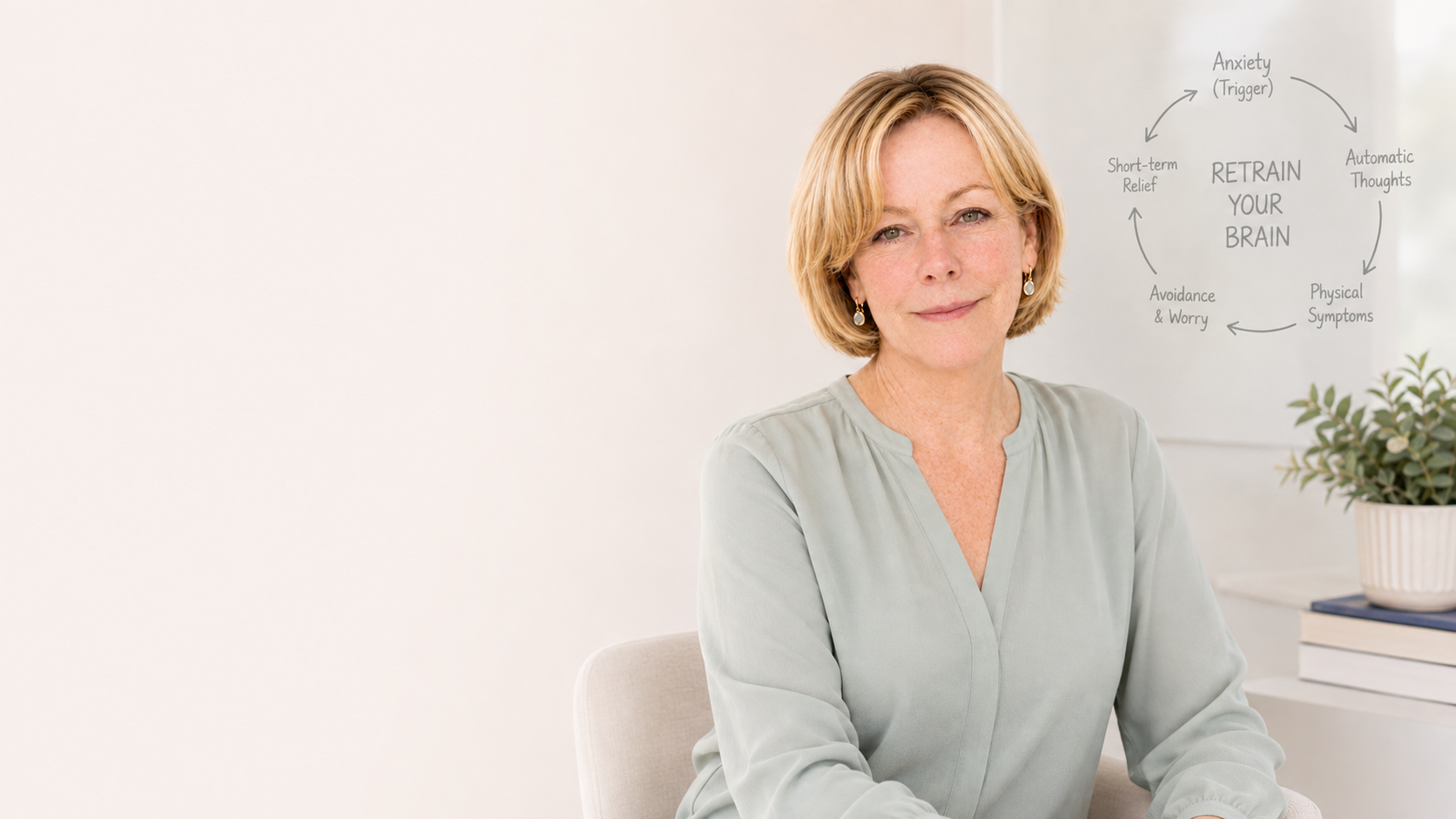
You were not born with anxiety.
Anxiety had to be learned — and what is learned can be unlearned.
That is the idea behind Retrain Your Brain.
What you’ll cover —
- Assessment & formulation — goals, baselines, your CBT map
- Cognitive skills — thought monitoring, thought records, cognitive restructuring
- Behavioural experiments
- Core beliefs & habit change — belief work, (neuroscience lens).
- Generalisation
- Relapse prevention
Use on its own, while waiting for therapy, or alongside therapy. Your completed worksheets travel with you if you start 1-to-1 later.
Dr Elaine Ryan
I am Dr Elaine Ryan, a Doctor of Psychology with over 20 years’ experience treating anxiety disorders and OCD.
I have worked clinically with anxiety for many years, including in the UK NHS as a Highly Specialist Psychologist. I also know anxiety from personal experience, having had panic disorder myself.
That combination matters.
I understand anxiety clinically, but I also know how frightening it can feel when your body reacts, your thoughts race, and you cannot seem to switch it off.
I created Retrain Your Brain® to make the psychological tools I use in practice available in a clear, structured, self-paced format.
Because I had anxiety myself, It's very important to me that I can help people with their anxiety; if this course is not helpful, it comes with a 10 day, no questions asked, full refund.

It's important you take time to look at the video as I talk you through what is inside the course.
For those who prefer to read, here is the full curriculum:
- Pathway 1: Your smart path to anxiety (5:47)
- Pathway 2: Your instinctual pathway (4:09)
- You're wired for the negative (10:43)
- Your 3 brains and anxiety (3:12)
- Your primitive reptilian brain (2:11)
- Your Mammalian Brain - now you can remember to be anxious (1:50)
- Your Thinking Brain - You're anxious because you are smart! (1:31)
What is inside the programme?
You get immediate access to a structured online course that you can work through in your own time.
You begin with guidance on how the course is structured, how to move through it, and how to use the resource library.
This helps you avoid dipping in and out randomly. You have a clear starting point.
The Different Pathways to Anxiety
You learn the different ways anxiety can develop and why it can feel different from person to person.
This section introduces the “three brains” teaching model that I use to explain anxiety in plain English:
- the instinctive alarm response
- the emotional/memory-based response
- the thinking/worry-based response
This gives you a map for understanding where your anxiety is coming from and why it may have become automatic.
Assessing Your Own Anxiety
You complete your own anxiety assessment and begin identifying the factors that may make you more vulnerable to anxiety.
This is important because anxiety is not the same for everyone. The more clearly you understand your own pattern, the easier it is to choose the right tools.
Calming the Different Pathways
You learn how to work with the different parts of the anxiety response.
This includes calming the instinctive body alarm, understanding emotional responses, and quietening the thinking brain when it is caught in worry or over-analysis.
Cognitive Behavioural Therapy
You learn CBT tools for anxious thoughts, beliefs, and behaviours.
This section helps you notice the link between what you think, how you feel, and what you do next. You learn how to question anxious thoughts, change unhelpful behaviours, and begin responding in ways that reduce anxiety over time.
Memory and Emotions
You learn how your brain can remember anxiety and attach fear to situations, sensations, or experiences.
This helps explain why anxiety can appear quickly, even when part of you knows you are not in danger.
Fear and Anxiety
You learn the role of fear and why the body reacts so strongly when your brain thinks there may be a threat.
This section helps you understand why anxiety symptoms feel so convincing, even when they are not dangerous.
The Symptoms of Anxiety
You learn about common physical symptoms such as heart palpitations, breathing difficulties, and body-based alarm responses.
Understanding symptoms can reduce fear of the symptoms themselves, which is often an important part of recovery from anxiety and panic.
Calming It All Down
You learn practical calming tools, including mindfulness, breathing, relaxation, sleep support, and guided exercises.
These tools are not presented as a quick fix. They are part of retraining your nervous system through repeated practice.
Distraction, Grounding, and Letting Go of Anxious Thoughts
You learn practical exercises to help you step out of anxious loops and bring your attention back to the present.
This is useful when your mind is racing, when you feel stuck in worry, or when anxiety is pulling you into repeated checking or rumination.
How to use the course
The course is very practical, teaching you skills that shall help. In the video below you can get an idea of how skills can be taught.
You do not need to rush.
You will have 12 months access, so you can move through the programme at a pace that suits you.
Some people prefer to watch several lessons close together to understand the full model. Others prefer to take one section at a time and practise before moving on.
The most important thing is not how quickly you finish.
The most important thing is repetition.
Anxiety becomes automatic through repeated patterns. New responses also need repetition. The course is designed to help you learn, practise, review, and build confidence gradually.
Is this the right first step for you?
Many people assume they either have to cope alone or start one-to-one therapy straight away.
That is not always the case.
For some people, especially when anxiety is mild to moderate, a structured self-help programme can be a sensible first step. It gives you a clear framework, teaches you what is happening in your mind and body, and gives you tools to practise in your own time.
This programme may be suitable if:
- anxiety is affecting your sleep, work, relationships, confidence, or daily life
- you feel anxious “for no reason” and want to understand why
- you get caught in worry, overthinking, or “what if?” thoughts
- you avoid situations because of anxiety
- you experience physical symptoms such as racing heart, tight chest, dizziness, nausea, tension, or panic-like feelings
- you have tried general advice before but want something more structured
- you want practical psychological tools, not vague reassurance
- This is not a replacement for emergency help, medical care, or individual therapy where that is needed. If your symptoms are severe, you are at risk of harming yourself, you are in crisis, or you have new or worrying physical symptoms, please contact your GP, emergency services, or an appropriate health professional.
Why anxiety gets stuck
Anxiety is meant to protect you.
Your brain and nervous system are designed to look for danger and help you respond quickly. That is useful when there is a real threat.
The problem is that the same system can start reacting to everyday situations, memories, thoughts, body sensations, or future worries as if they are dangerous.
Over time, your brain can learn anxious patterns.
You might start avoiding places, checking symptoms, replaying conversations, planning for every possible outcome, or scanning your body for signs that something is wrong.
These responses can make sense in the short term because they give temporary relief. But repeated often enough, they can teach your brain that anxiety is necessary.
That is why anxiety can become automatic.
The aim of this programme is to help you understand those automatic patterns and begin practising new responses.
Not by pretending everything is fine.
Not by trying to “think positive.”
But by learning how anxiety works and using practical tools to change the way you respond.
How this programme helps you understand and change anxiety
Anxiety usually shows up through a pattern of:
- what you feel in your body
- what you think
- what you do or avoid
This programme helps you identify which pathway is most active for you. Some people are dominated by body-based alarm responses. Some are caught in learned situational fear. Some are trapped in thought and worry loops. Most have a mixture.
Once you understand your pattern, the work becomes much clearer. You learn grounding, CBT, mindfulness, exposure-based practice and attention-training tools that match the type of anxiety you are actually dealing with.
You were not born doing all of these anxious habits. They were learned. And learned patterns can be changed.
Wonderfully set out, easy to understand.
The course is presented in such a way that it's easy to understand, yet provides detailed information for greater clarity on why we experience anxiety and how to retrain your brain. I have a much better understanding now and have learned good strategies. Thank you!
I don't have the finances to see a professional in person and this has been so helpful.
Thank you for putting this together. I do not have the finances to see a professional in person and this has been so helpful. I did a few other online therapy programs, but none had a road-map or actual educational material and exercises to help me. This was the first time I felt I got something concrete.
You were a blessing in my life, Dr. Elaine! A true Godsend!
You have helped me SO much!!! Literally, my anxiety is so much better and I can recognize it more and work through my thoughts. This course has even helped me help my husband with his anxiety! You were a blessing in my life, Dr. Elaine!
I have read other professional books and Dr. Ryan gives a similar, understandable perspective
I have read anxiety books and Dr. Ryan gives a slightly different but similar perspective on anxiety. I think she makes the topic very understandable... I did get some real benefits from this, and I'm glad I took the course. It was a worthwhile investment.
What Our Users Are Saying
I was in a dark place ... this has been so helpful.
THANK YOU, Elaine. Wow, I was in a dark place when I began your courses, and I can't tell you enough how helpful this has been. I was struggling with intrusive thoughts which led down the rabbit hole of anxiety. Though I am not free from them, I feel much better about handling them and feel prepared to do so. Thank you again!
